Rather Than Lamenting What You Lack, Be Grateful for What You Have
From the Great Buddha Hall of Todai-ji, I head north. After a short walk, the crowds around the hall fall away, and on the gentle slope only a few people are to be seen. To the left, the grounds of the Shoso-in storehouse run along behind a fence. Turning at the corner where a signpost stands and climbing a long flight of stone steps, I come to Chisoku-in, one of the sub-temples of Todai-ji. It is said to be the northernmost temple within the Todai-ji precinct.
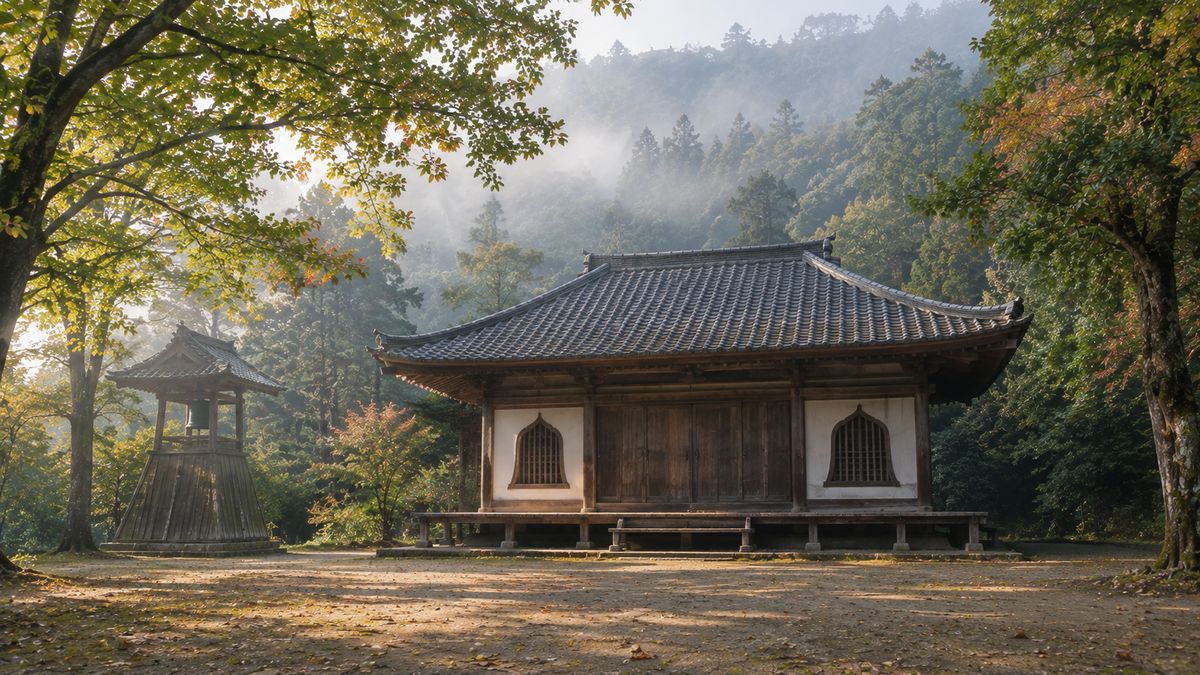
It is said to have been founded in 890. After falling into ruin, it was restored in the Kamakura period and became a place of study for the Hosso school of Buddhism. The current main hall was rebuilt in 1863; on either side of its white walls are cusped windows shaped like temple bells. In one corner of the grounds stands a small bell tower. In late spring, the Nara double cherry first found here opens its flowers later than the other cherries. Under the name Chisoku-in Nara-no-Yaezakura, it was designated a national natural monument in 1923. It is still a little early for the autumn leaves.
The principal image is a standing wooden statue of Jizo Bosatsu from the Kamakura period. It is a hidden Buddha, shown to the public only once a year, around the Jizo festival in July. This Jizo has another name: the Letter-Bearing Jizo. In 1180, the forces of Taira no Shigehira set fire to the temples of Nara, and the Great Buddha Hall of Todai-ji burned down. The following year, Fujiwara no Yukitaka was appointed to oversee the rebuilding of Todai-ji, and he gave all he had to the work alongside the monk Chogen. Yet he passed away without seeing it finished. His daughter, left behind in grief, is said to have joined her hands in prayer before this Jizo every day.
In today's world, things and convenient services are overflowing.
Compared with the old days, when there were no things, when there were no convenient services, the standard of living of people today has risen remarkably.
So why is it that we feel a sense of lack, and spend our days unfulfilled?
It is because there is this side to it: precisely because things and convenient things are overflowing, we chase after them without end.
It is a worry that comes precisely because things exist without limit.
There is also this side: when people feel anxious, they unconsciously try to fill that with something, and chase after things and convenient things.
To solve these, we must 'know what is enough.'
And we must be aware that we are blessed, that we are fulfilled, and feel at ease.
Rather than lamenting what we lack, let us be grateful for what we have.
You are more blessed than you think.
It was on the morning of the seventh day. In the Jizo's hand, a letter was found. It was written in her father's handwriting, and it said that he was now in Tosotsu-ten, the Tushita Heaven. From this story, the statue came to be called the Letter-Bearing Jizo. Chogen, it is said, wished to repay Yukitaka's efforts, and appointed his family to oversee one of Todai-ji's estates. Before going back down the steps, I look up at the roof of the main hall. Even on its tiles, I can see the three characters of the temple's name, Chisoku-in: the hall of knowing what is enough. As I walk down the slope, the bustle around the Great Buddha Hall slowly draws near again.