As Many Kinds of Justice as There Are Standpoints
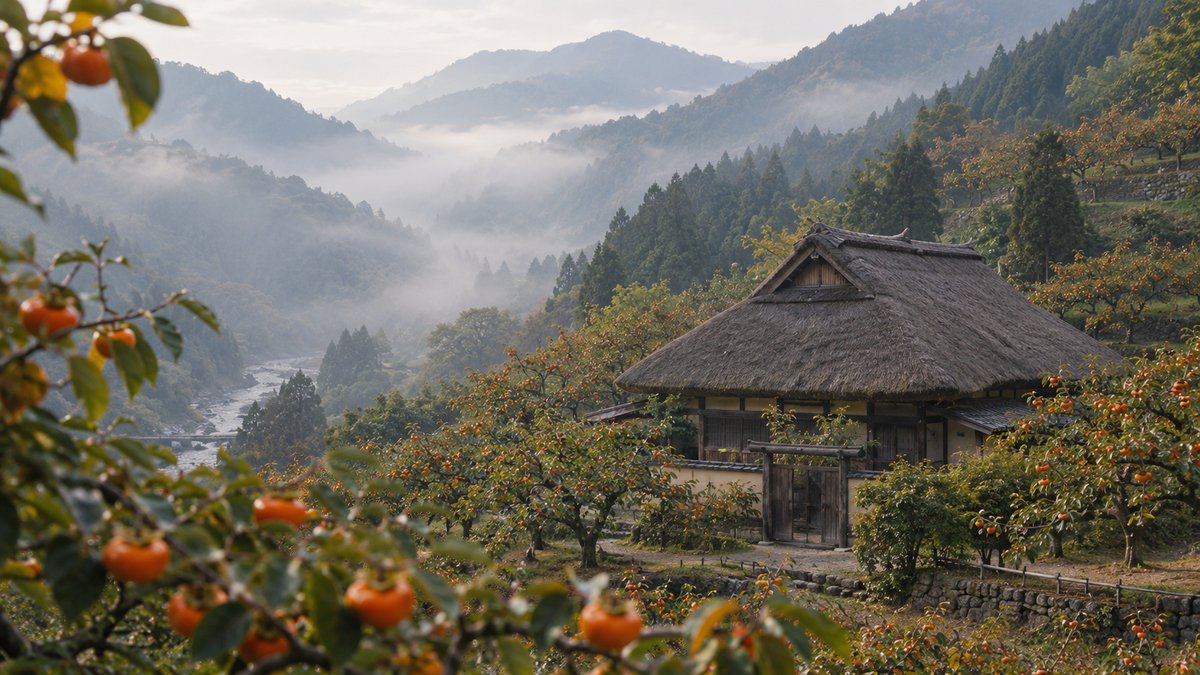
October has come. In Nishi-Yoshino, in the city of Gojo in southwestern Nara, a road climbs into the mountains along the Niu River, which flows into the Yoshino River, and slope after slope is covered with persimmon trees. The harvest of Tone-wase persimmons, first shipped in mid-September, is now at its height. Nurtured by the mountain air, warm by day and cool by night, the fruit is slowly turning orange among the green leaves.
In that valley of the Niu River lies the village of Ano. In one corner of the village stands a large old home with a thatched roof: the Hori family residence. In 1336, Emperor Go-Daigo, driven from Kyoto by Ashikaga Takauji, is said to have taken shelter here on his way to Yoshino, in the home of a local landowner of the Hori family. The residence later became the imperial palace of three emperors in turn: Go-Murakami, Chokei and Go-Kameyama. The main building standing today is believed to date from the late Muromachi period, and it has been designated an Important Cultural Property of Japan. A northern court in the capital, a southern court deep in the mountains of Yamato: this was the age of the Northern and Southern Courts, when two imperial courts stood side by side.
This place was once called Anafu. Emperor Go-Murakami, wishing for the hopes of the Southern Court to come true, renamed it Kanafu, a name that echoes the word for 'to be fulfilled,' and later, it is said, to celebrate that the wish had come true, gave it the characters that are pronounced Ano today, the first of which means 'celebration.' Then, in 1352, the three retired emperors of the Northern Court, Kogon, Komyo and Suko, together with Prince Naohito, who had once been crown prince, were brought to Ano by the Southern Court. That same year, the retired Emperor Kogon took Buddhist vows in this mountain village.
Every person has what we call a standpoint of their own.
As we go through life, we sometimes forget this obvious truth.
And that is why things stop going well.
Never take one side's standpoint and point a finger at the person who stands on the other side.
The other person has their own side of the story.
It is not a matter of which one is right and which one is wrong.
There are as many kinds of justice as there are standpoints.
What matters is that we are considerate of one another.
If we can do that, things begin to turn smoothly.
It was five years before Kogon returned to the capital. In his last years he devoted himself to Zen practice at Joshoko-ji, a temple in the mountains of Tamba. The Taiheiki, the great chronicle of this age, tells that the former emperor, now a monk, called on Emperor Go-Murakami at his court during a journey through the provinces. The emperor was already weeping before they met, and the two spent a day and a night talking of many things, it is said. Whether this truly happened is still not known for certain. In Nishi-Yoshino in October, the persimmons go on turning orange, one by one. Above the thatched roof in Ano, autumn clouds drift slowly by.