Let Us Find the Courage to Face Ourselves
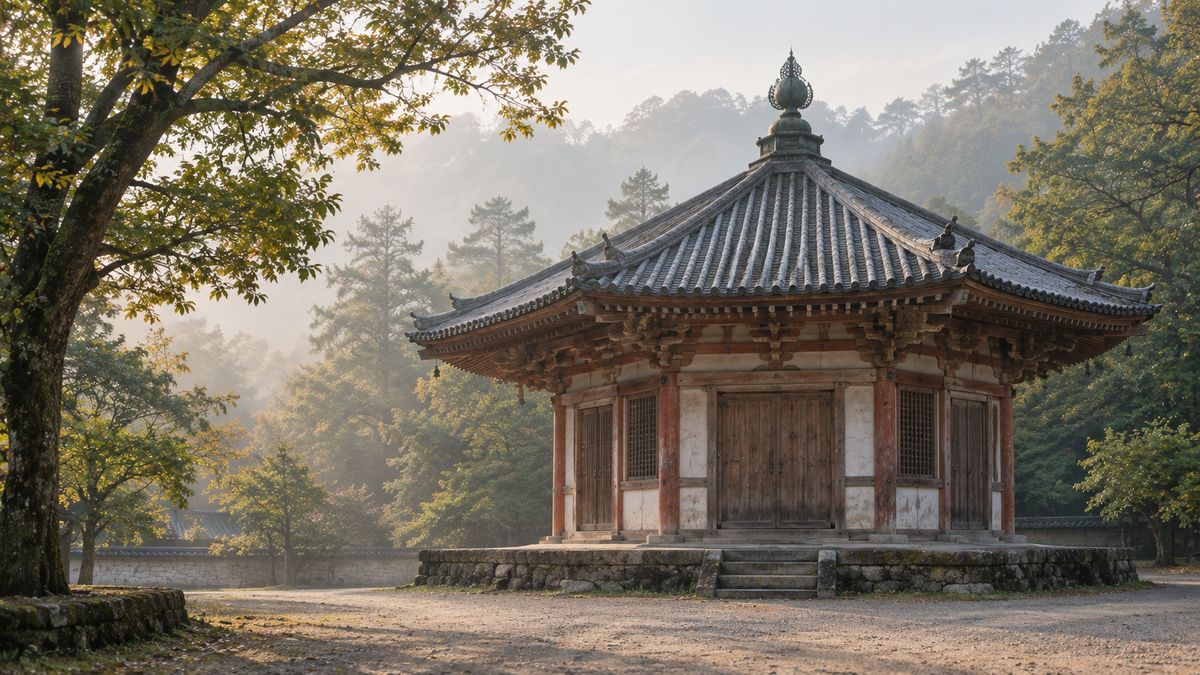
At the western edge of the grounds of Kofuku-ji Temple stands an eight-sided hall called the Hokuendo. It was built in 721, in the Nara period, for the first anniversary of the death of Fujiwara no Fuhito, the founder of Kofuku-ji, by order of Empress Gemmei and Empress Gensho, who entrusted the work to Prince Nagaya. It is said that this spot once looked out over the whole of the capital, Heijo-kyo. For honoring the spirit of Fuhito, who had driven the building of that capital, there could hardly have been a more fitting place. The hall standing today was rebuilt around 1210, yet it is still the oldest building remaining at Kofuku-ji.
Its doors are usually kept shut, and visitors may enter only during special openings. At the center sits a statue of Miroku, the Buddha of the future, completed around 1212 by Unkei, late in his life, together with the sculptors of his workshop. Beside it stand two figures nearly two meters tall: Muchaku and Seshin, known in Sanskrit as Asanga and Vasubandhu, two brothers who were Buddhist monks in India. The elder, Muchaku, has the face of an old man; the younger, Seshin, the face of a man in his prime. Under Unkei's guidance, the elder's figure was carved by Unjo, and the younger's by Unga. More than eight hundred years on, they are often said to look as if real people were standing there.
The two were born around the fourth or fifth century in Purushapura, in the region of Gandhara, today's Peshawar in Pakistan. The younger, Seshin, first studied in a school called Sarvastivada, and came to be known as its greatest scholar. And he is said to have criticized the Mahayana teachings his elder brother taught.
Near you, there are probably one or two people you dislike.
The reasons you dislike them may vary, but there is something we tend to overlook.
It is this: perhaps you dislike that person because, without realizing it, you find in them the parts of yourself that you dislike.
Perhaps you dislike them because they show you the parts of yourself you dislike and would rather not see.
Other people are a mirror of ourselves. As the saying goes, see how others behave and mend your own ways. It is not quite that, but if, in the parts you dislike in the person you dislike, you find the parts of yourself that you dislike, then all you need to do is face them squarely and mend them within yourself.
Then that person you dislike will no longer bother you.
And, strangely enough, you will probably no longer dislike them either.
Let us find the courage to face ourselves.
According to the Life of Vasubandhu, translated into Chinese by Paramartha, the elder brother pretended to be ill and called the younger back to their homeland. As he studied the Mahayana teachings at his brother's side, the younger came to see their depth, and he set out to cut off his own tongue, the tongue with which he had once spoken against the Mahayana. His brother stopped him and, it is said, told him this: if that tongue spoke against the Mahayana, then from now on, let that same tongue teach it. Seshin went on to write many treatises, among them works on the Consciousness-Only teaching, and died at the age of eighty. His teachings were later carried to China by Xuanzang, and from there across the sea to Japan, where they are still handed down at Kofuku-ji, head temple of the Hosso school. Behind the doors of the Hokuendo, the two brothers stand quietly side by side today.