Before Pointing at Others, Reflect on Yourself
Near the very middle of the Nara Basin lies Yao, in the town of Tawaramoto. Turn a little west off the main road, and a vermilion torii gate comes into view. At the end of a tree-lined approach stands Kagamitsukuri Shrine, formally Kagamitsukuri-ni-imasu-Amateru-Mitama Shrine. Since ancient times it has been revered as the shrine of the deity of mirror casting.
One of its deities, Ishikoridome, is thought to be the very craft of mirror-making given the form of a god. According to the shrine's tradition, in the age of Emperor Sujin, when a mirror to hold the spirit of the sun goddess Amaterasu was cast on this land, the first mirror cast as a trial came to be enshrined here as the shrine's divine body. This area appears as Kagamitsukuri, the mirror-making village, in the Wamyosho, a dictionary of the Heian period, and from the fourth to the fifth century, a group of craftsmen known as the Kagamitsukuri-be lived here and made mirrors.
In the grounds is a pond called Kagami-ike, the Mirror Pond. The mirror makers are said to have purified themselves here and washed the mirrors they had made. Beside the pond rests the Kagami-ishi, the Mirror Stone, said to have come out of the pond in the Edo period. Its top is hollowed into a round dip, and it is thought to have been used when the surfaces of mirrors were ground smooth and bright.
People rarely reflect on themselves.
That is because needless pride gets in the way.
To reflect on ourselves, we need the courage to cast off misplaced pride.
Before pointing at others or at the people around us, let us reflect on ourselves.
Surprisingly often, the cause lies within ourselves.
If we reflect on ourselves and take the best course of action, others, the people around us, and the circumstances in which we find ourselves will improve to a surprising degree.
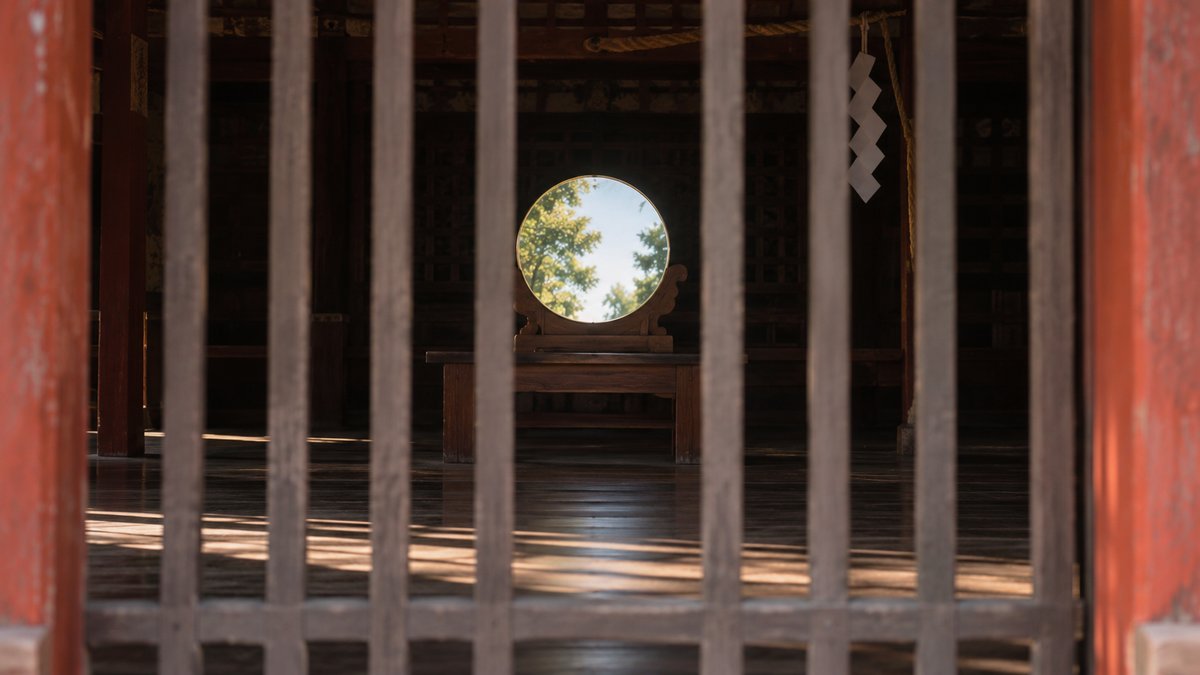
Mirrors of old were made of metal. With daily handling, their surfaces slowly grew cloudy, and the figures they showed grew blurred. In the Edo period, there were craftsmen called kagami-togi, mirror grinders, who went from door to door and ground cloudy mirrors bright again. Once the work was done, a mirror showed a clear image once more. Peer into the worship hall of Kagamitsukuri Shrine, and beyond the latticework, at the center, a mirror glints. A burnished mirror says nothing. It simply shows whatever stands before it, just as it is.