Choosing Good Actions, Together
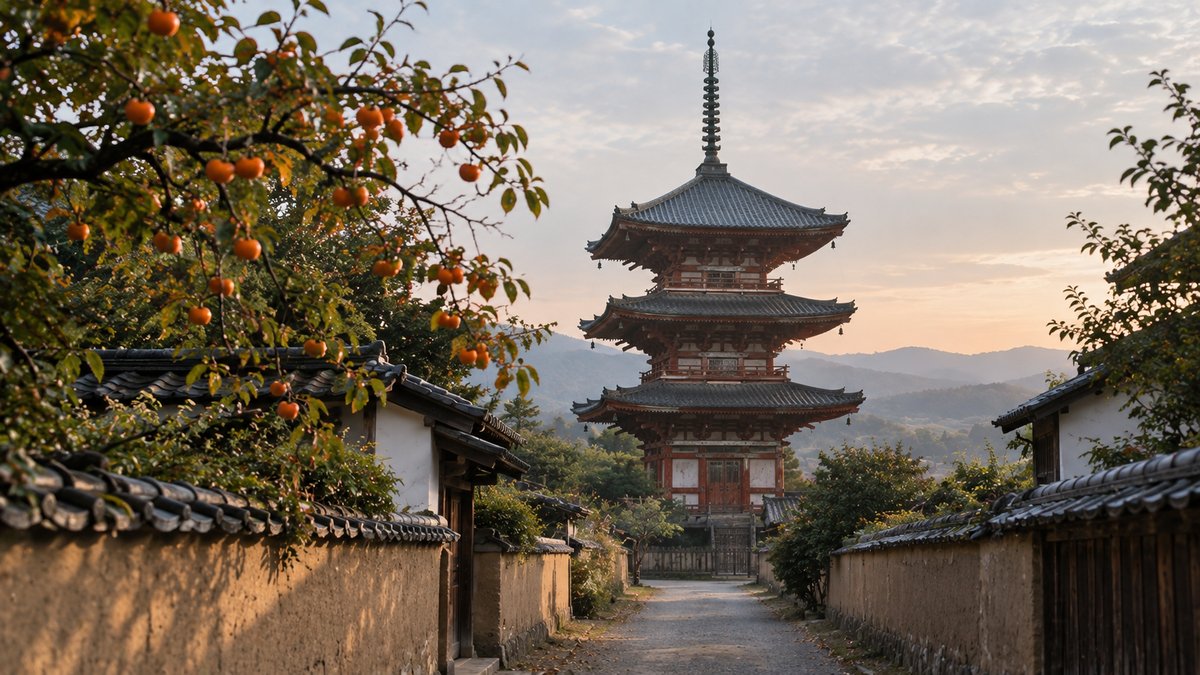
In the northern part of the Ikaruga countryside, in a small village called Mii, stands Horinji Temple. Between the fields and the rooftops, its three-story pagoda comes into view. Together with the five-story pagoda of Horyuji and the three-story pagoda of Hokkiji, it is one of the pagodas known as the Three Pagodas of Ikaruga. Yet the pagoda standing there today is not the one that had stood since the Asuka period.
In the summer of 1944, the pagoda, which had been a National Treasure since the Meiji era, was struck by lightning and burned to the ground. It was wartime, and its lightning rod is said to have been taken down so the metal could be handed over for the war effort. The pagoda lost its National Treasure status, and with it any hope of public help. Two generations of the temple's priests, father and son, traveled the country asking for donations to rebuild it. Then the writer Koda Aya joined them. She had once watched the five-story pagoda of Yanaka in Tokyo burn, the pagoda that had served as the model for her father Koda Rohan's novel The Five-Storied Pagoda, and she is said to have felt that this was no stranger's matter. In time, the circle of supporters grew to twenty thousand people across Japan.
When construction began in 1972, heated arguments broke out again and again between the designer, Dr. Takeshima Takuichi, and the master carpenter, Nishioka Tsunekazu. The professor wanted to reinforce the pagoda with iron, so that even if one day no one remained who knew the old Asuka methods, people in later ages could still repair it. Nishioka would not give way. Iron, he insisted, would harm the wood and shorten the pagoda's life. 'Do that, and the cypress will weep.' Both of them spoke out of the same wish, that the pagoda would stand for a long time. In the end, it is said, they agreed to keep the iron to a bare minimum.
It often happens that something we did for others and the people around us, meaning well, meets with unexpected resistance.
At such times, let us look closely at what we did.
Was it not self-righteous?
While saying it was for others and the people around us, was it not, in truth, for our own sake?
What matters is to communicate well with others and the people around us, and to take good actions together, all of us.
What we think is 'good for everyone' is not necessarily 'good for others and the people around us.'
Once the work began, volunteers from the village set their farming aside for a whole year and came to the site day after day to help. 'We have got to go to the pagoda!' That, it is said, was their watchword. In the spring of 1975, the pagoda rose again on the same spot, in the same form it had before the fire. Thirty-one years had passed since it burned. The convictions of the two men who argued, the wishes of twenty thousand people far away, the sweat of those who left their fields to come and help, all of it now rests within a single pagoda. When a breeze crosses the Ikaruga countryside, the bronze bells hanging from its eaves sway, giving out a small, dry ring, karan, karan.